
Mizuno Pro M13 vs. Callaway X Forged Irons: What My Fitting Data Actually Showed
The numbers, the Reddit community feedback, and why I went with the Mizuno M-13s
I've been playing the same irons for over 5 years. They're not the problem. This I know. But I've had a persistent right miss with longer irons that's cost me enough strokes to justify a closer look. So I booked a fitting at a local shop with a full TrackMan setup and tested five configurations. Here's what the data actually showed.
What I Was Looking For
The right miss shows up consistently with the 6-iron and longer. Short irons and wedges are fine. But push it to a 5-iron with any speed and there's a chance I'm hunting for it right. Not a huge miss, but a pattern.
There's also a compensation I've built in over time: I address the ball with a slightly closed face to account for the occasional push. My fitter flagged this. More on that below. The setup change that the irons might enable matters as much as the spec itself.
I wanted to know if equipment could be part of the fix, or at least stop making things harder.
The Fitting Data
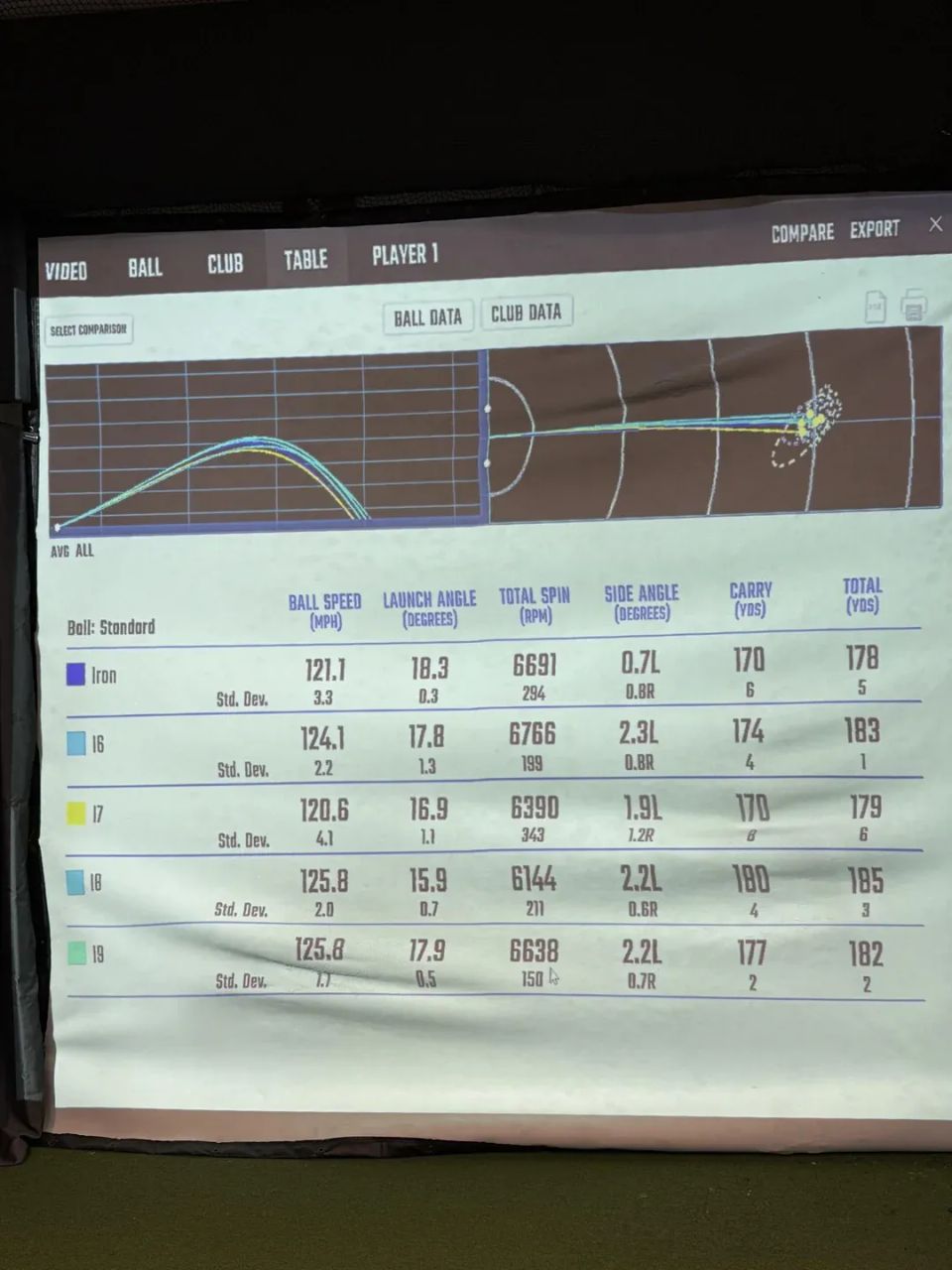
Everything was hit with a 7-iron. Five configurations tested, all with the same ball. The last two, the Callaway X Forged and the Mizuno M-13, were the finalists.
| Club | Ball Speed | Launch | Spin | Side Angle | Carry | Total |
|---|---|---|---|---|---|---|
| Current irons | 121.1 mph | 18.3° | 6,691 rpm | 0.7L | 170 yds | 178 yds |
| Test 2 | 124.1 mph | 17.8° | 6,766 rpm | 2.3L | 174 yds | 183 yds |
| Test 3 (T100s) | 120.6 mph | 16.9° | 6,390 rpm | 1.9L | 170 yds | 179 yds |
| Callaway X Forged | 125.8 mph | 15.9° | 6,144 rpm | 2.2L | 180 yds | 185 yds |
| Mizuno M-13 | 125.8 mph | 17.9° | 6,638 rpm | 2.2L | 177 yds | 182 yds |
On raw distance, the Callaway wins by three yards total. But it gets there with a lower, flatter ball flight at 15.9° launch and 6,144 rpm of spin. That combination makes it harder to hold greens, especially from longer distances. The Mizuno matched ball speed identically at 125.8 mph, but came in at 17.9° launch and 6,638 rpm, which was much closer to my current iron's flight profile, just with more speed.
The trend that mattered most, though, was consistency.
| Club | Ball Speed SD | Spin SD | Total Yards SD |
|---|---|---|---|
| Current irons | 3.3 | 294 | 5 |
| Callaway X Forged | 2.0 | 211 | 3 |
| Mizuno M-13 | 1.1 | 150 | 2 |
The Mizuno produced nearly three times tighter ball speed consistency than my current set. Total yardage standard deviation of 2 yards versus 5 with what I'm playing now. The Callaway was better than current (SD of 3) but the Mizuno was in a different category entirely.
What the Fitter Observed
Two things came out of the session that weren't on the launch monitor.
First, on lie angle: the fitter tested at 2 degrees flat and we ultimately ordered 1 degree flat. His read was that my dynamic impact was returning the club heel-heavy, which was causing the face to stay open slightly at impact. Going flat corrects this as the heel-heavy return brings the face back to neutral when the lie is adjusted flat. One degree felt like the right increment; 2 degrees was a meaningful change but pushed things too far in the other direction.
Second, he noticed I set up with a closed face at address. I wasn't even aware I was doing this. The logic for getting away with it is obvious: if the club wants to open at impact, set it closed at address and they cancel out. The problem is that it creates a ceiling. You can't fully commit to the swing — the fear of the left miss is always there, even subconsciously. The hypothesis with the spec change is that if the lie brings the face to neutral at impact, I can set up neutrally too. And from a neutral setup, I can actually release the club fully.
That last part matters more than the dispersion numbers. A full release from a neutral setup means more speed, not less.
What Reddit Said
I posted the TrackMan data to r/GolfSwing and got a useful mix of responses.
The first wave was skeptical. The top comment questioned whether any differences were meaningful given the sample size, and that's fair. Five shots per club isn't a definitive dataset. Another commenter pointed out that the gap between the Callaway and the Mizuno on total distance was small enough to fall within normal shot-to-shot variation.
The more detailed analysis pointed in a different direction. One commenter noted that the T100s showed lower launch and spin than expected, something to think about if you're looking for a workable iron that holds greens. Another flagged that the Callaway's lower spin profile would be a liability in firm conditions, which is exactly the scenario where the distance advantage matters least.
The pushback on sample size was the most honest counterargument. One commenter suspected the numbers could be partly explained by swing variation across sessions. That's legitimate, and I don't dismiss it. But the consistency data in my view wouldn't change much with a larger sample.
The thread confirmed what I'd concluded from the data, with a few useful additions I hadn't considered.
The Decision
After a bit of wavering, I ordered the Mizuno M-13s, 1 degree flat.
The case for the Callaway was real. Three more yards is three more yards, and a lower-spinning iron works for players who already hit it high. But I don't need to hit it lower. I need to hold greens. The launch and spin profile on the Callaway would have made that harder, not easier, especially on longer approaches.
The Mizuno matched my existing ball flight with better speed and significantly tighter dispersion. From a scoring perspective, dispersion beats distance almost every time. One wayward approach costs more strokes than three yards of extra carry gains. The math isn't complicated.
There's also the setup piece. If the 1-degree flat spec lets me address the ball more neutrally and swing without managing a left miss, that's a benefit that doesn't show up anywhere in the TrackMan data. It's speculative, but it's the kind of upside that compounds over time if it works.
What Comes Next
The clubs aren't in hand yet. The real test is what happens when I actually play them on a range, on a course, and ultimately in competition. I'll document that when the time comes.
The more interesting question isn't whether the dispersion holds. It's whether I can actually change the setup habit. Whether I can stand over a 5-iron with 180 yards to the pin, wind in my face, and set up neutrally without the voice in the back of my head. That's a harder adjustment than lie angle.
More to come.
-CG
If this kind of breakdown is useful, I send one analysis per week to subscribers — drills, data, and what's actually moving my handicap. Free to join, no spam.